
 Español

When two suppliers quote you for the same specification of DTF film, the numbers can look almost identical on paper — yet the actual buying experience can be completely different. One supplier might ship from a coating factory with a six-week lead time and a full-pallet minimum. The other might ship from a domestic warehouse in three days with a single-carton order. Neither is automatically the better deal.
The terms “manufacturer” and “wholesaler” describe a supplier’s position in the supply chain, not a guarantee of quality, price, or reliability. Before committing to a bulk order of DTF film roll wholesale, it helps to understand exactly what each channel offers — and where the real trade-offs sit once freight, customs, defect rates, and inventory carrying costs are factored in, not just the raw wholesale pricing per roll.
This guide compares manufacturers and wholesalers across the criteria that actually affect a bulk buyer’s bottom line: total landed cost, order volume and flexibility, product consistency, customization, lead time, technical support, and supply-chain risk. In short: manufacturers tend to suit buyers with predictable, high-volume demand and customization needs; wholesalers tend to suit buyers who value lower minimum orders, faster delivery, and simpler procurement. Many established operations end up using both.
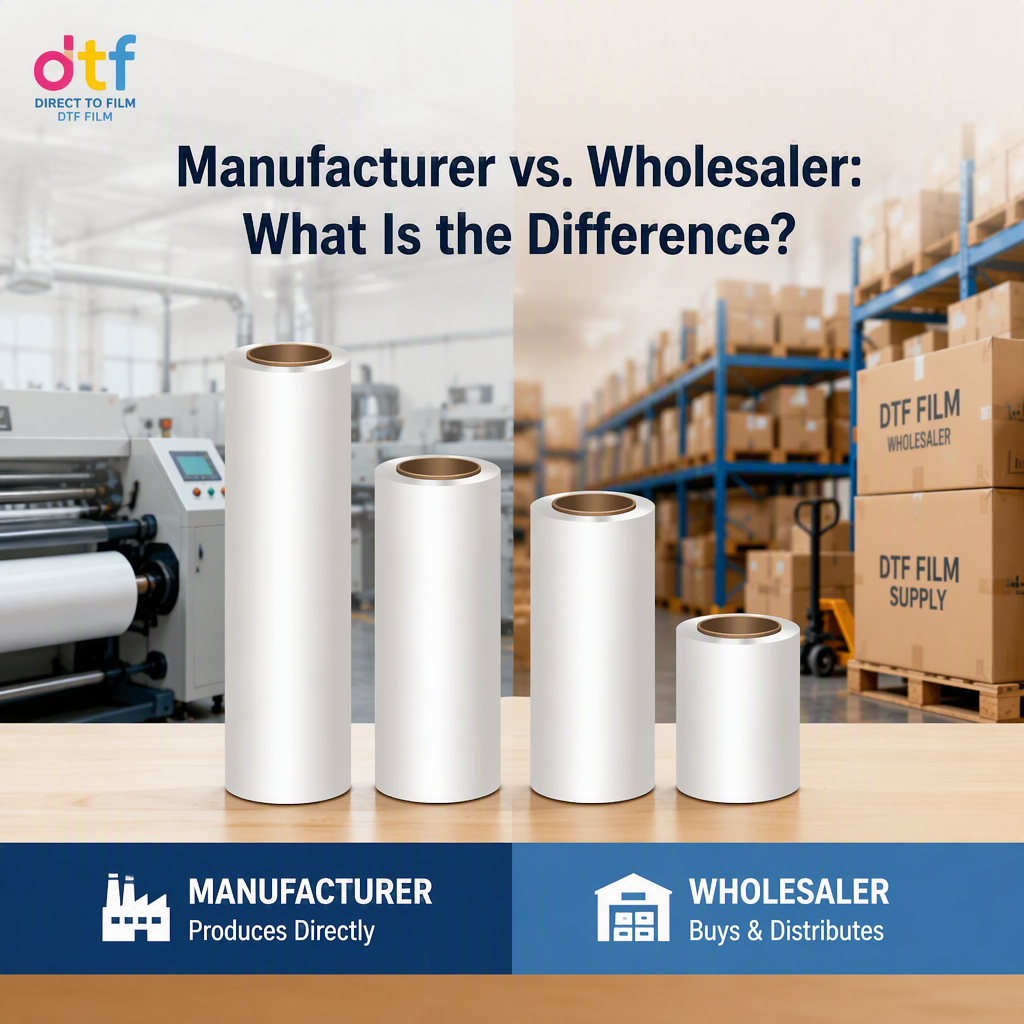
Manufacturer vs. Wholesaler: What Is the Difference?
What a DTF Film Manufacturer Does
A genuine DTF film manufacturer produces or coats PET film inside its own facility. That means it controls raw-film selection, coating formulation, drying, slitting, inspection, and packaging from start to finish. Because it owns the production line, a manufacturer can typically offer OEM or private-label production and adjust specifications — width, thickness, peel behavior, coating side — to a buyer’s exact requirements. Pricing is usually structured in volume tiers, with factory-level minimum order quantities (MOQs) tied to production runs rather than shelf inventory.
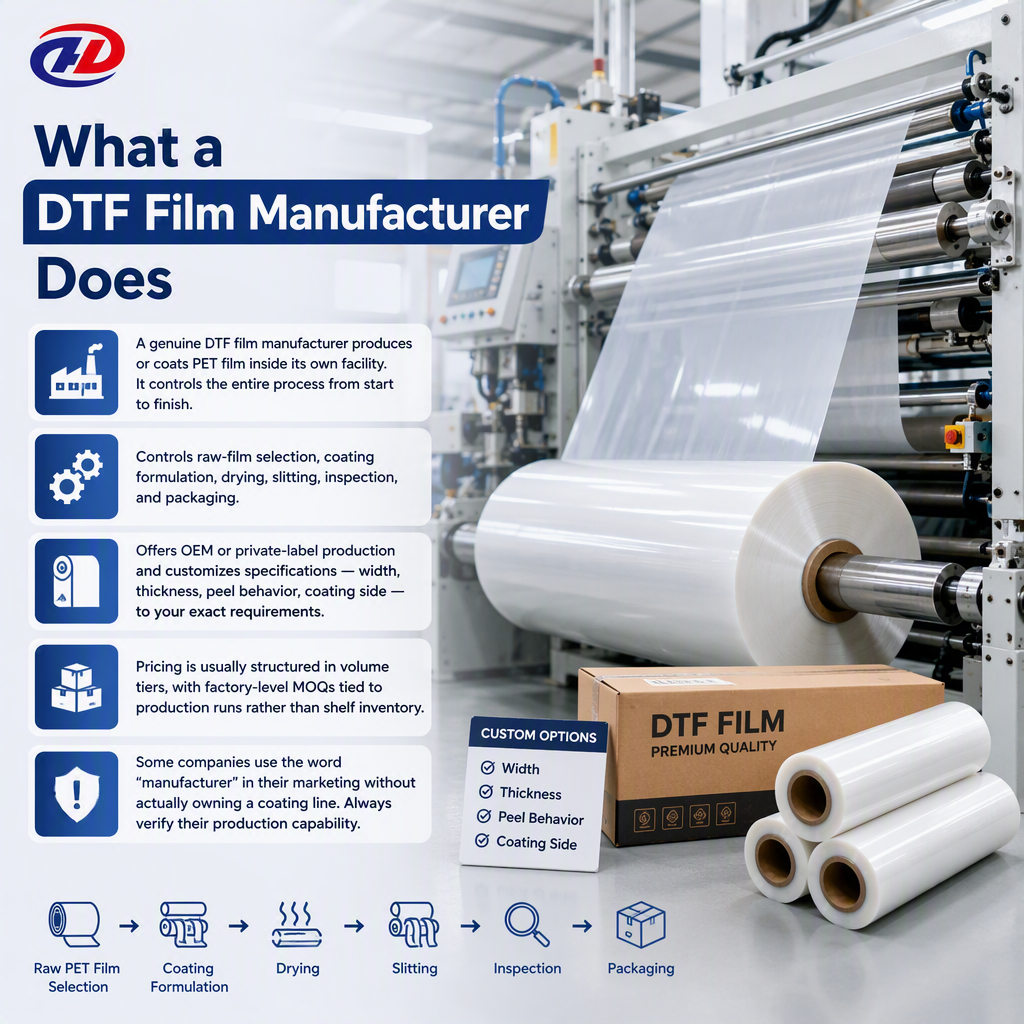
It’s worth noting that some companies use the word “manufacturer” in their marketing without actually owning a coating line. Understanding how DTF film is manufactured and the role of the PET film material in the process makes it easier to ask informed questions and spot the difference.
What a DTF Film Wholesaler Does
A wholesaler purchases finished film from one or more manufacturers and resells it, often holding regional inventory for faster delivery. Because a wholesaler isn’t tied to one production line, it can typically offer smaller quantities, a wider assortment of widths, finishes, and film types, and simpler logistics — domestic shipping, familiar payment terms, and easier returns. The trade-off is less direct control over how the film was produced, and sometimes less visibility into which factory supplied a given batch.
Why the Distinction Can Be Difficult to Verify
Labels aside, the only reliable way to know who you’re actually buying from is to ask direct questions: Does the supplier own or operate the coating line? Can it produce production and quality-control records? Is it the exporter of record, or does it route through an intermediary? Will it allow a live or recorded factory audit? Does its business license and registered address match the claimed production site? A supplier that hesitates on these questions is worth treating cautiously, regardless of which label it uses.
Visual: a simple flow — raw PET resin moves into a coating factory, then either directly to a bulk buyer or through a wholesaler/distributor before reaching the print shop.
Quick Comparison for DTF Film Roll Wholesale Buyers
The table below summarizes how the two channels typically compare across the factors that matter most for bulk purchasing decisions.
| Purchasing Factor | Buying from a Manufacturer | Buying from a Wholesaler | Typical Best Fit |
|---|---|---|---|
| Unit price | Lower at high volume | Higher per roll, no factory markup layer removed | Manufacturer for scale |
| MOQ | Higher, often full carton/pallet | Lower, sometimes per-roll | Wholesaler for small buyers |
| Custom widths/lengths | Available with lead time | Limited to stocked sizes | Manufacturer |
| Private labeling | Often available | Rarely available | Manufacturer |
| Product range | Usually one film line | Multiple brands/types | Wholesaler |
| Production transparency | Higher, if verifiable | Lower, batch source may vary | Manufacturer |
| Quality consistency | Depends on QC maturity | Depends on incoming inspection | Case by case |
| Sample availability | Usually available | Usually fast to arrange | Tie |
| Lead time | Longer, production-based | Shorter, stock-based | Wholesaler for urgency |
| Local stock | Rare | Common | Wholesaler |
| International freight responsibility | Usually the buyer’s | Usually the wholesaler’s | Wholesaler simplifies |
| Returns and claims | Slower, cross-border | Faster, domestic | Wholesaler |
| Payment terms | Often deposit + balance | Often more flexible | Wholesaler |
| Technical support | Deeper on production issues | Stronger on application issues | Depends on issue type |
| Supply continuity | Strong if capacity is reserved | Depends on factory relationships | Case by case |
In short: manufacturers usually suit stable, high-volume, specification-driven orders. Wholesalers usually suit lower or variable volumes, urgent replenishment, and simplified logistics. A hybrid approach — using both — often works best for businesses that need core inventory plus emergency stock.
Price Comparison — Which Supplier Is Actually Cheaper?
Ex-Factory Price vs. Wholesaler Markup
In theory, a manufacturer removes one layer of markup, so direct pricing advantages should increase as order size grows. In practice, low advertised factory prices often depend on very large MOQs or a limited set of standard specifications. Wholesaler pricing, meanwhile, bundles in inventory holding, handling, local support, and delivery convenience — costs a manufacturer would otherwise push back onto the buyer in the form of freight, storage, and risk.
Calculate Total Landed Cost, Not Price per Roll
Comparing quotes on a per-roll basis is misleading unless every cost component is included. A more accurate framework is:
Total landed cost per usable roll = (Product cost + packaging + freight + insurance + duties/taxes + customs/brokerage + bank fees + storage + inspection + expected defect loss) ÷ usable rolls received.
Before comparing two quotes, confirm: Is shipping quoted as EXW, FOB, CIF, DDP, or domestic delivered pricing? Are cores, cartons, pallets, labels, and moisture protection included in the price? Who pays if rolls arrive damaged or with incorrect specifications? And how does the expected defect rate change the effective price per usable roll?
Hidden Costs That Can Erase Factory Savings
Buyers who compare only the ex-factory number often get surprised later by: overseas freight rate fluctuations, customs delays that tie up cash and disrupt production schedules, the carrying cost of large minimum-order inventory, currency conversion and wire transfer fees, third-party inspection fees, rework caused by inconsistent release or coating performance, cash tied up in unused stock, and eventual discounting or disposal of slow-moving film that didn’t sell or perform as expected.
When a Wholesaler’s Higher Unit Price Can Cost Less Overall
A higher per-roll price from a wholesaler can still produce a lower total cost for buyers with small monthly consumption, frequent rush orders, limited warehouse space, a need for domestic returns, plans to test a new film type or width before committing, or a habit of purchasing mixed SKUs rather than one standard product. For these buyers, the convenience and speed often outweigh the per-unit premium — see this breakdown of DTF film wholesale price factors for a deeper look at what drives quoted prices.
MOQ, Order Flexibility, and Inventory Risk
Typical Manufacturer Ordering Conditions
Manufacturers commonly require a minimum number of rolls or a minimum order value, and often expect full-carton or full-pallet quantities. Custom coatings, non-standard widths, custom packaging, or private branding typically raise the MOQ further. Production scheduling and deposit requirements are standard, though some manufacturers offer a smaller trial order for new B2B customers to build trust before scaling up.
Typical Wholesaler Ordering Conditions
Wholesalers generally allow lower MOQs, sometimes down to individual rolls, and let buyers combine different widths and peel types in a single order. This makes it easier to adjust quickly to seasonal demand swings, though quantity breaks are usually smaller than what a factory-level commitment would unlock.
Match MOQ to Inventory Turnover
Before accepting any MOQ, calculate average rolls consumed per week or month, the safety-stock level you need, your shelf-storage conditions, your cash-conversion cycle, and how reliable your demand forecast really is. The key question is simple: how many months of inventory will this MOQ create, and can you use it all before quality degrades or it ties up working capital you need elsewhere?
Quality Control and Batch Consistency
Where DTF Film Quality Differences Appear
Film quality problems tend to show up in specific, measurable ways: uneven coating, poor ink absorption, weak white-ink density support, inconsistent powder adhesion, static buildup, film that isn’t flat, heat resistance that varies by batch, inconsistent release behavior, dimensional instability, poor edge quality or winding tension, and visible defects such as oil marks, scratches, pinholes, or coating contamination.
Manufacturer Quality-Control Advantages
A manufacturer with mature systems has direct control over coating formulas and production settings, can trace issues to a specific batch or lot, can adjust production parameters when something goes wrong, and can share real inspection data. The important qualifier: these advantages only exist if the manufacturer actually has documented QC systems and is willing to prove it — not every self-described factory does.
Wholesaler Quality-Control Advantages and Limitations
Wholesalers can screen multiple factories and switch if one underperforms, run their own incoming inspection, keep replacement stock on hand, and draw on experience across many printer configurations. The limitation is less influence over coating changes at the source, the possibility of switching factories without disclosing it, and reduced batch-level traceability compared to buying direct.
Quality Documents and Tests to Request
Regardless of channel, ask for a technical data sheet, a certificate of analysis or batch inspection report, film thickness and tolerance data, clear coating-side identification, the recommended peel-temperature range, recommended curing and pressing settings, storage conditions and shelf-life statement, lot number and production date, a compatibility declaration for the DTF inks and powders you use, and a written defect-allowance and claims procedure.
Conduct a Production-Representative Sample Test
Before placing a bulk order, test the film using your actual printer, ink, powder, shaker, curing unit, and heat press — following the correct operation settings for your equipment. Print solid white areas, gradients, fine text, high-coverage graphics, and large blocks. Test on multiple fabrics and colors, run repeated wash and stretch tests, and request several rolls or samples from different batches rather than a single hand-selected sheet, which won’t reveal batch-to-batch variation.
Product Selection and Customization
Standard Specifications Bulk Buyers Should Define
Before comparing quotes, define your requirements clearly: roll width and length, PET thickness, whether you need single-sided or double-sided coating, matte or glossy finish, hot peel, warm peel, cold peel, or universal peel behavior, anti-static treatment, core diameter, roll winding direction, and packaging or pallet configuration.
Manufacturer Customization Options
Manufacturers can typically offer custom roll widths and lengths, release-speed adjustments, coating optimization, branded cartons, labels, cores and inserts, full private-label product lines, and specialty or application-specific film. Keep in mind that customization usually requires technical validation, a higher MOQ, a longer lead time, and written acceptance criteria agreed before production begins.
Wholesaler Product-Range Advantages
Wholesalers often carry multiple film brands, allow mixed orders of standard and specialty products, make side-by-side testing easier, and lower the risk of introducing niche products like glitter or reflective film since you’re not committing to a full factory production run to try them. Browse the current range of DTF film products, including hot-peel and cold-peel options, or view specific formats such as hot peel DTF film roll, single-sided DTF film roll, and double-sided DTF film roll.
Lead Time, Shipping, and Supply-Chain Reliability
Manufacturer Lead-Time Factors
Lead time from a manufacturer depends on raw-material availability, the current production queue, coating and curing schedules, any custom slitting or packaging requirements, factory holidays, export documentation, and the transit time for ocean, rail, air, or courier freight.
Why Wholesalers Can Deliver Faster
Wholesalers typically deliver faster because they hold regional inventory, use domestic courier or freight networks, sell in smaller replenishment quantities, and shift customs and import responsibility away from the buyer. That said, a wholesaler relying on a single factory or shallow stock levels can still experience stockouts, so speed shouldn’t be assumed without verification.
Questions That Reveal Supply Reliability
Before committing to either channel, ask: What is the normal production or dispatch time? What quantities are currently in stock? What is the monthly production capacity? Is safety stock reserved for contracted buyers? Are backup production lines or supplier relationships in place? How are delays communicated? Are partial shipments permitted? And can the supplier offer an annual supply agreement?
Consider a Dual-Sourcing Strategy
Many established buyers use a manufacturer for forecastable core volume while keeping a vetted wholesaler on standby for urgent replenishment and specialty products. The key is approving an equivalent backup film through testing before an emergency happens, and tracking lot performance so untested substitutions don’t slip into production.
Technical Support, Returns, and Accountability
Support When Buying Direct from a Manufacturer
Buying direct can offer access to coating or application technicians, the ability to investigate defects at the batch level, and troubleshooting that goes deeper than general press-setting advice. Weigh this against language barriers, time-zone gaps, and response speed.
Support When Buying Through a Wholesaler
Wholesalers often provide local-language communication, familiarity with regional printers and consumables, faster replacement logistics, and clearer domestic returns. The trade-off is that a wholesaler may not always be able to identify the production cause behind a recurring defect.
Put the Claims Process in Writing
Whichever channel you choose, get the claims process documented in the contract: the inspection window after delivery, the acceptable defect rate, required evidence (photos, videos, lot numbers, test results), the remedy — replacement, credit, refund, or rework — who pays return freight, how consequential losses or downtime are treated, and the rules for unopened versus partially used rolls.
Which Option Is Better for Different Bulk Buyers?
Choose a Manufacturer When…
Monthly demand is stable and high enough to meet the MOQ, lower long-run unit cost is a priority, custom dimensions, coating behavior, or private labeling are required, your team can manage importing and warehousing, you can conduct supplier audits and incoming QC, and your demand forecast is reliable.
Choose a Wholesaler When…
Demand is smaller, seasonal, or unpredictable, fast domestic delivery matters more than the lowest ex-factory price, you need mixed sizes or film types, warehouse capacity and working capital are limited, easy returns and local support are priorities, or you’re still testing DTF film before scaling up.
Use Both When…
Core products sell consistently but specialty-film demand varies, direct imports can cover planned production while local inventory covers emergencies, you want supply-chain redundancy, or you’re transitioning gradually from wholesale purchasing toward factory-direct sourcing as volume grows.
Buyer-Fit Decision Matrix
Score your business against these factors — monthly roll consumption, forecast stability, need for customization, available working capital, warehouse capacity, import experience, required delivery speed, internal QC capability, and tolerance for supply disruption — and you’ll typically land in one of three categories: mostly manufacturer, mostly wholesaler, or hybrid sourcing.
How to Vet a DTF Film Manufacturer or Wholesaler
Verify the Supplier’s Business Model
Check the legal company name and registration, factory and office addresses, evidence of production equipment, employee count and production capacity, export records where legally available, whether invoices come from the same entity that signs the contract, and references from comparable B2B customers.
Request a Detailed, Comparable Quotation
Make sure every quote you compare includes the exact film specification, quantity and MOQ, price tier, Incoterm, packaging details, lead time, sample cost, payment terms, quote-validity period, warranty and claims conditions, and estimated shipment size and weight. Comparing incomplete quotes side by side is one of the most common sourcing mistakes.
Audit Production and Quality Systems
Where possible, check incoming PET inspection procedures, coating controls, drying and curing controls, slitting accuracy, dust and contamination management, roll-winding consistency, batch traceability, finished-product testing, and storage environment. Reviewing the broader DTF film manufacturing capabilities of a supplier and understanding the film manufacturing process in general makes it easier to ask pointed, credible questions during an audit.
Use a Staged Purchasing Process
A safer path into a bulk relationship follows these steps: review documentation and confirm supplier identity, test standard samples, place a small commercial trial order, evaluate multiple rolls and lots, measure the defect rate and press performance, confirm how responsive the supplier is to corrective action, then scale to a full bulk order and establish periodic supplier reviews going forward. If you’re ready to compare options, reach out for a specification-based quotation.
Final Decision Checklist
Before signing off on a bulk order, confirm the following: What is the true monthly and annual demand? Is the MOQ commercially realistic for that demand? What is the total landed cost per usable roll, not just the quoted price? Does the supplier actually produce the film, or resell it? Has the film been tested on your complete production setup? Are lot traceability and QC records available on request? Are delivery times and stock commitments documented in writing? Who is responsible for customs, damage, defects, and returns? Is customization genuinely necessary, or simply nice to have? Do you have backup inventory or a second approved supplier? And are payment milestones and product specifications written into the purchase agreement?
The decision rule that ties all of this together: choose the supplier channel that produces the best risk-adjusted total cost — not simply the lowest quoted price per roll.
Conclusion — The Best Supplier Depends on Buying Scale and Risk Tolerance
At sustained scale, factories tend to offer stronger economics and more customization. Wholesalers tend to offer flexibility, speed, and easier local service, especially for smaller or less predictable order volumes. In either case, verifying the supplier’s real business model and testing film on your own production setup matters far more than which label — manufacturer or wholesaler — appears on the quote. Before making a decision, request like-for-like quotes built on identical specifications and landed-cost assumptions so you’re comparing offers fairly.
Ready to compare options? Explore available DTF film options or request samples, technical documentation, and a bulk quotation based on your exact specifications.
Frequently Asked Questions
Is it cheaper to buy DTF film directly from a manufacturer?
Usually, yes, at sufficiently high order volumes — but only after freight, duties, inspection, storage, expected defects, and financing costs are included in the comparison, not just the ex-factory price.
What is a typical MOQ for wholesale DTF film rolls?
MOQs vary widely by supplier, roll specification, packaging, and customization level. Rather than comparing roll counts alone, evaluate the MOQ by total inventory value and how many months of use it represents for your business.
How can I tell whether a DTF film supplier is a real manufacturer?
Verify business registration, the production address, evidence of coating equipment, process and batch inspection records, willingness to allow an audit, and whether the company is actually the contracting and exporting entity on your invoice.
Should I buy hot-peel or cold-peel DTF film in bulk?
Base the decision on your workflow, equipment, fabric type, desired finish, and your own verified test results rather than the peel label alone. See this comparison of the difference between cold tear and hot tear DTF film for more detail.
Can manufacturers provide private-label DTF film?
Many manufacturers can produce custom labels, cartons, cores, roll dimensions, or coating adjustments, though this typically comes with higher MOQs and a longer qualification period before full production begins.
What should I test before placing a large DTF film order?
At minimum, test ink absorption, powder adhesion, release consistency, winding quality, static behavior, color output, wash resistance, stretch performance, and consistency across several different batches — not just one sample roll.
Is it safer to use more than one DTF film supplier?
Dual sourcing can reduce the risk of a stockout, but every backup film should be approved through your own production testing before it’s used on a live order, so an untested substitution doesn’t create a quality problem under pressure.